
For a self-professed data geek, this may be a curious article for me to write. As much as I love data, I know an over-reliance on our gadgets can impede our training progress by leading us to make choices that don’t match a workout’s objective, by making incorrect judgments about our fitness, or by sucking the fun out of training.
Our watches are tools. And just like a hammer won’t help us when we need to loosen a screw, our smart watches may not be the best tool for every training and racing situation.
In this article, I share 6 of the most common ways that an overreliance on smart watches can lead to making “dumb” choices.
1. Is this thing on?
Our smart watches still need us to do stuff to make them work to their potential. Most of these watches are not simply “turn on and go”. Take the time to review the user manual, which is usually online, or to watch tutorial videos on YouTube. You’ll find some great ones for the most popular brands and models.
Here’s a general list of things you want to know:
- How to sync your watch with TrainingPeaks.
- Location of the start/stop button and lap button. This may sound simple, but in the middle of a session, you want to be able to pick the button you want.
- How to customize the data screens for each sport mode and type of workout. For example, I have one screen for running that is specific to speed work intervals and one screen that is specific to long endurance work.
- Understand how to pair your watch with other devices, such as your HR strap, power meter, smart trainer, and training platform. Ideally, your coach has at least one file from a training session that has all of the requisite data in a single file.
- Understand how to pair your watch and/or bike computer with cycling training platforms, such as Zwift. This is important to ensure the power meter from your bike is where the data comes from, rather than the smart trainer. There is almost always a difference between the power coming from your bike’s device and the smart trainer.
- How to turn off the wrist HR monitor, also referred to as optical monitors. Wrist-based monitors are almost always inaccurate and lead to issues with trend-based data. So, if you forget your strap or it stops working during a session, take the time to turn off the wrist HR.
- How to use drill mode for swimming (this may be dependent on the type and model of watch you have)
- How to set up using a structured workout (if you choose to use structured workouts)1. Is this thing on?
2. Numbers or Die
Despite the cliche, numbers do not speak for themselves. Numbers – whatever they are – are also interpreted by humans. And, numbers are symbols, so they are a representation of an actual thing – but not the thing itself. For example, if your CTL (chronic training load) is 60, that is a representation of your fitness based on training load – but not your actual fitness.
When your coach lays out training targets, they are simply our best estimate, based on previous training history, threshold, and typical conditions. Training targets are not mandates. They are guidelines that need to be interpreted by you and your coach.
On most days, it likely isn’t an issue to hit your target ranges. But, on any given day, this estimate may not fit with the circumstances. Maybe you need sleep. Or it is 97 degrees with 90% humidity. Perhaps you aren’t fully recovered from the monster session you had the day or two prior. Maybe your body is fighting a bug.
Whatever the reason, sometimes we don’t hit our numbers – BUT the effort can still be the correct one for the day. (More on this in the next point.)
The data collected by our wearables is not the same thing as the effort itself. Our bodies don’t understand the numbers related to our effort – they only understand the effort we exert.
Sticking to watts or a pace – no matter what the cost in terms of inappropriate HR or RPE – is a “numbers or die” approach. In this case, the technology (and our ego’s response to the information it provides) leads us to make a poor decision, which disrupts the intention and purpose of the workout. While we may have hit the “normal” pace or watts, we missed the intention of the workout.
3. You feel the signs I’m sending?
Our bodies are smarter than our watches. Full stop.
But we have to be smart enough to listen to the signs our bodies send us. As such, one of the most important things we can do as athletes is to cultivate our body awareness.
Part of body awareness involves developing a well-defined sense of RPE (rating of perceived exertion). We need to understand what an effort should feel like. Hone your body awareness in training by taking account of the sensations you feel at various effort levels in differing conditions. For example:
- How do your muscles feel at the beginning, middle, and end of a particular type of workout?
- What is your respiratory rate like when you are working easy, steady or hard?
- At what point can you feel your body shifting from being primarily aerobic to primarily anaerobic?
- How do these sensations change when it is cold or hot? When you go up or downhill? When you are on smooth or technical terrain?
At some point, you want to get so good at this that you can guess your heart rate, pace, or power – just based on the different sensations in your body.
Come race day (or training session), if the numbers don’t feel right or your technology isn’t working (GASP!), you can feel confident adjusting because you know how an effort should feel in your body. Make adjustments to get the best out of yourself on the day.
4. Watches Are SOOOO Judgey
“Unproductive” “Losing Fitness” “97 Hours of Recovery Needed” – you name it! Our watches offer pronouncements on our fitness, based on proprietary algorithms that mash up details such as our HR, pace, power, thresholds, age, weight, and the like.
Ugh. SOOOO judgey. Also, sooooo wrong many times.
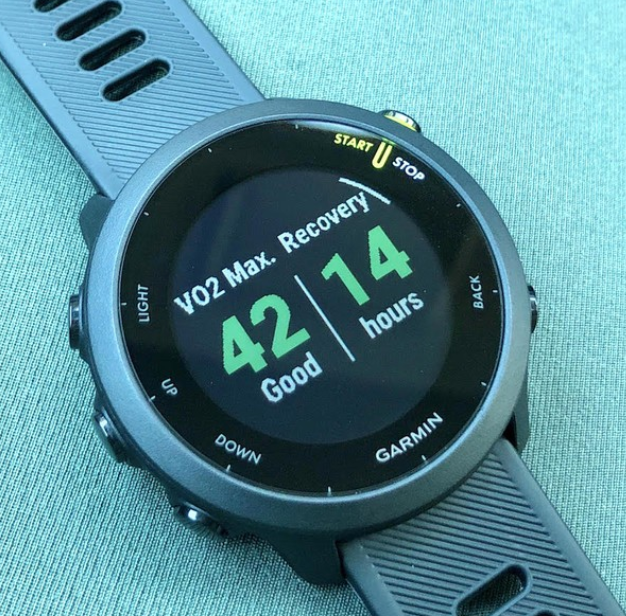
Our “smart” watches are trying to write checks that their algorithms aren’t able to cash. So, don’t accept their notes about whether you are gaining or losing fitness, being productive, having the VO2 max of a slug, or needing 97 hours of recovery.
I’m happy to report that our watches are not smarter than your coach!
The algorithms are based on statistical averages, and while that may seem reasonable, a medical average is a very small slice of the population. In my years of coaching, I’ve learned each athlete is an N=1. And, while the research and medical averages can give us a starting place, they are most often not usable as is for most athletes. In other cases, these predictions are inaccurate or unreliable because they are based on indirect measurements, such as the case of VO2max.
VO2max refers to the maximum (max) rate (V) of oxygen (O2) you can consume during exercise. This is a laboratory-derived value. Watches estimate this number, but the research suggests that they do so poorly.
A collection of studies found that Garmin watches (using either chest or wrist strap) tend to over or underestimate VO2max when compared to direct lab testing. Wrist-based assessments are also more inaccurate than chest-based assessments. It should be noted that both types were inaccurate when compared with direct lab measurements for VO2max. As such, it makes the use of watches to determine VO2max inconclusive at best. (Read more here.)
In other cases, our watches rely – at least in part – on readings from wrist-based monitors, which are often inaccurate and unreliable when we are moving. The research suggests that these monitors perform better at rest, so some of the sleep-oriented data may be more accurate. Even still, don’t rely on a watch to tell you how you are feeling. Get in touch with your body and cultivate that feeling.
When your watch wants to tell you that you are losing fitness or being unproductive, please ignore it. Better yet, if you can, turn OFF those functions. Your coach has your back, and the expertise to analyze the data, as well as the experience to provide individualized advice for your body as an N=1.
5. Wait, what’s the workout again?
When structured workouts first became available, coaches and athletes alike began using them for their benefits. If you use structured workouts, however, you’ve likely had the scenario when the workout didn’t import correctly, or it was missing, or was otherwise unavailable in your watch, or on your training platform (such as Zwift).
Back in the old days, when we had to run uphill both ways for our warm-ups and cool downs, we used to write our workouts on our hands, on scraps of paper, or try to memorize them. While this had its issues too, it was always good for making sure we understood the workout before we started.
Even if you rely on structured workouts, it is good practice to make sure you review the workout and understand its intention. If you find the workout doesn’t import correctly, you can still execute what is planned.
6. Where is the fun?
Training and racing should be fun. Sure, some days it may be more like Type 2 or 3 fun – but fun nonetheless.
Sometimes, being stuck to our devices can suck out the fun. While chasing targets can often be invigorating and a sign of our growing fitness and ability, after a long season or during some of the roughest weeks of build training, having a “naked” swim, ride, or run can be a great release from needing to stay dialed in to a specific target.
If you find you are getting a bit burnt by the numbers game, talk with your coach and let them know. We can always schedule a “naked” session that frees you from the technology and lets you get in touch with the freedom of movement. These sessions can also be a great way to get in touch with your RPE.
Our technology offers a useful tool to help us train to our best – but it is only a tool. When it isn’t working correctly, or it is giving us crap data, that’s a good time to remember that we are always smarter than our technology.
Ultimately, our training is designed to prepare us to meet or exceed the demands of race day. When our smart technology gets in the way of that goal, we have to shift to manual mode and call our own shots. When it comes to the myriad of data that our watches provide us, be sure to speak with your coach about what it means for you individually.
Our watches are great training tools. But they are one of several tools we can use. Be sure to grab the right tool for the job at hand.
Ready to train smarter—not just harder? Our coaches at No Limits Endurance Coaching help you understand the why behind every workout so you can perform your best on race day. 👉 Reach out to us to learn how personalized coaching can take your training to the next level.