
A Simple Tool To Determine Your Effort
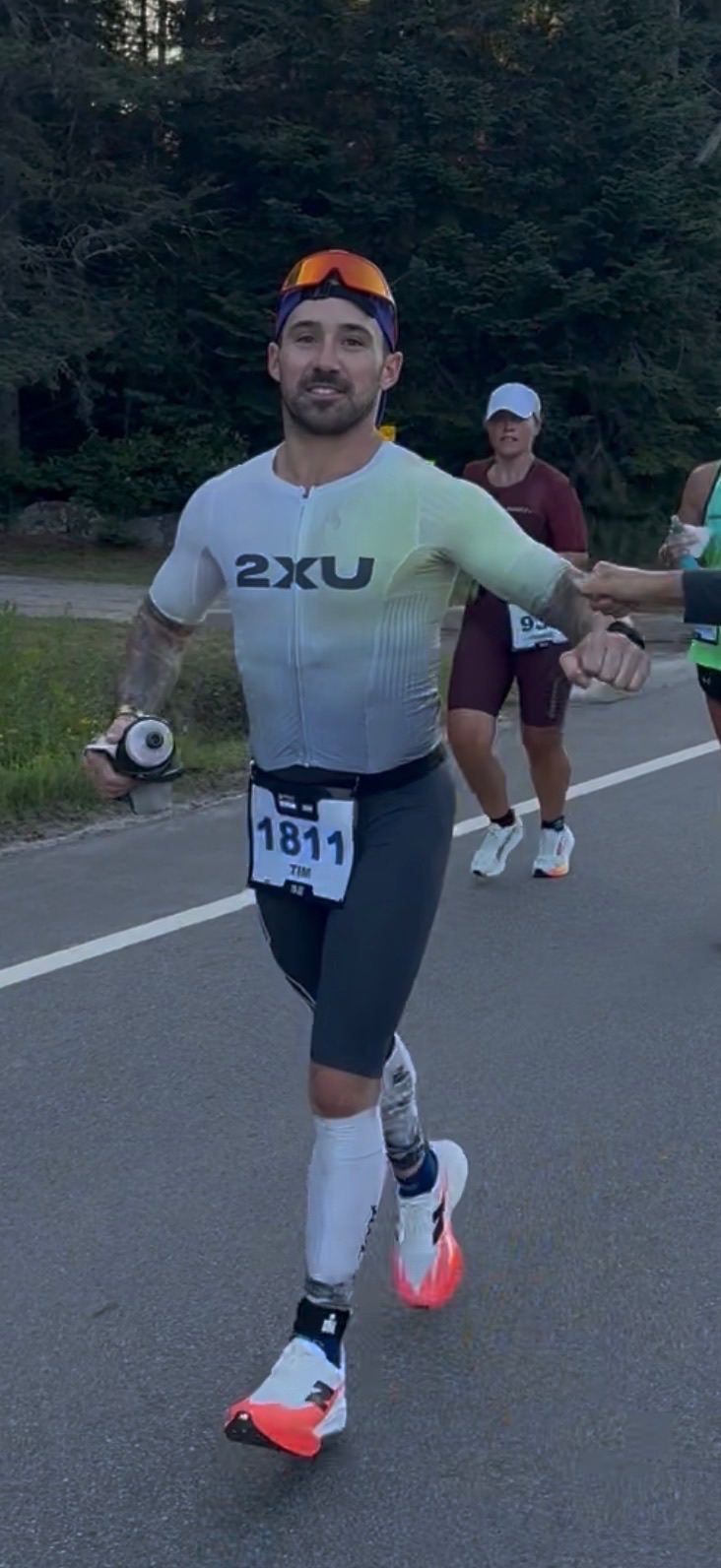
It never fails: your coach asks you what your RPE was for a session, and you just aren’t sure what to say. You find it challenging to assign a number to the effort, even though you are well aware of the sensations you felt. This leaves you wondering: Did I do it right? What if the number targets aren’t the right intensity? What if I’m training too hard, too easy?
No metric is perfect, so we should always use all available metrics when we train, including our rate of perceived exertion. But if you find yourself struggling to figure out the rate of perceived exertion (RPE), the talk test will help.
The talk test doesn’t require fancy equipment or complex calculations but it provides invaluable guidance for optimizing your endurance training.
So, what exactly is the “Talk Test”?
Understanding the Talk Test:
The “Talk Test” allows you to gauge your exercise intensity based on your ability to speak while working out. The principle is simple. If you can maintain a conversation without gasping for breath, your exercise intensity is likely within the optimal range for endurance training.
Here’s a breakdown of the different levels, and how they correspond to our zones at No Limits Endurance Coaching.
| Zone | Talk Test “results” | When to apply this effort | RPE |
| Low Intensity, Zone 1 | You can speak effortlessly and continuously. | Warm-ups, cool down, recovery sessions | 1-3 |
| Steady Aerobic Intensity, Zone 2 | Conversation is possible, but you may need to take deeper breaths between sentences, but you can continue to speak with undue effort. | Endurance Training | 4-5 |
| Moderately-Hard, Zone 3 | You can speak about one sentence before needing to take a deeper breath. | Tempo efforts, low-end sweet spot efforts | 6-7 |
| Hard, Zone 4+ | Speaking is difficult.
Short phrases only in zone 4. Possibly no speaking at all from Zone 5 and up. |
Threshold, VO2max and HIIT. | 8-10 |
Is the Talk Test Valid?
The short answer: Yes! Studies have found useful correlations between various intensity markers, as measured by heart rate, pace and power, and an athlete’s application of the talk test. In these studies, the talk test was found to be both accurate and reliable, however, not quite as fine tuned as some of the training targets we might use for heart rate or power. But, it serves as an excellent complement to these tools, and as a way to double-check that the zones developed via testing are accurate and reliable.
However, like any assessment, there are limitations. These include:
- Subjectivity: Individual perception of effort can vary, impacting the accuracy of the test.
- Specificity: Different activities engage different muscles, potentially affecting the talk test response. Additionally, an effort can be muscularly hard, while not as hard cardiovascularly.
- Additional factors: Heat, humidity, altitude, sleep disruptions, and other external factors can influence breathing independent of intensity.
How to Apply the Talk Test:
- Choose your exercise: Running, swimming, cycling, rowing, walking – you name it. The talk test works across all these endurance disciplines, and more. For swimming, you may find that humming works better than talking, as it can be challenging to actually talk under water.
- Find your voice: Ask a friend to accompany you or you can have a nice chat with yourself. It is important to talk out loud for this to work. So, if you are solo, just know you’ll need to talk to yourself.
- Dial in the intensity: Gradually increase your effort until you reach a point where your breath rate/talk rate matches up with the table above.
As you get used to using the talk test in your regular training, take it to the next level, by doing one or all of the following:
- Combine with heart rate and power. Connect your breath rate to heart rate zones and power zones. Then, start to bring RPE into the mix. This gives you a holistic sense of how hard/easy you are working, which aids you on race day.
- Measure progress over time. As your fitness improves, you’ll be able to maintain conversation at faster paces or higher power levels. This is often a sign that you need to increase your zones!
- Listen to your body: Don’t solely rely on the talk test, pay attention to fatigue, muscle soreness, and recovery times.
The Body Knows
While we are all eager to try the newest wearables, and get the latest tech, let’s not forget that the body has its own internal sensors that help us determine our effort. In this regard, the “Talk Test” stands out for its simplicity and effectiveness – not to mention it’s a cost effective “gadget”.
This doesn’t mean that I recommend throwing out your heart rate strap or power meter. Quite the opposite! Rather, I advocate that you use all available metrics to increase your body awareness, which is one of the most powerful skills an athlete can have. When you combine these metrics – the objective and the subjective – you set yourself up to make effective and successful decisions for your race day execution.
Want help dialing in your training?
Understanding your effort, training zones, and how your body responds to different intensities can make a big difference in your training and race-day execution. At No Limits Endurance Coaching, we help athletes take the guesswork out of training with personalized coaching and support.
Ready to train with more confidence? Reach out to us and let’s talk about your goals.