
Music’s Impact on Endurance Training and Racing
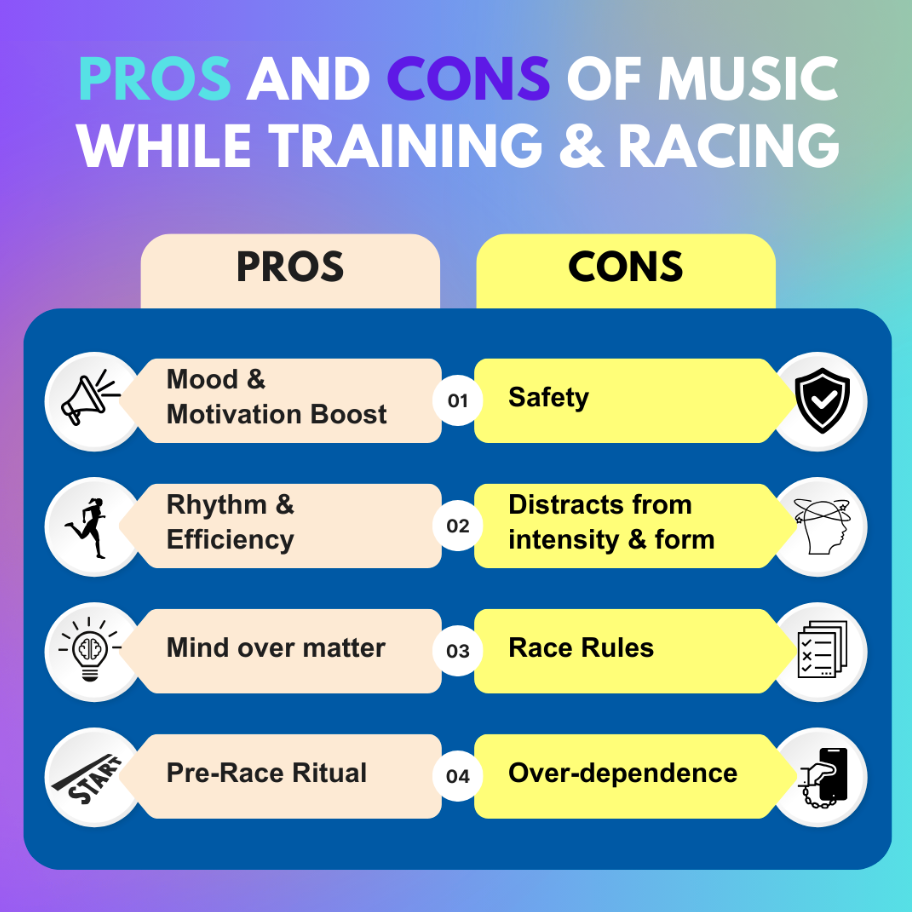
I love listening to music when I train. Give me a good beat, and I’ll be ready to run through brick walls to get that workout done and dusted. Many athletes feel similarly, and we’ve come to rely on music to help us drown out fatigue, and propel us towards the finish line.
But is music merely a motivational crutch, or is there a scientific basis to its power in endurance training and racing?
Cue up your favorite background music, as we delve into the pros and cons of using music for peak performance.
Pros:
- Mood & Motivation Boost: A 2015 study in the Journal of Sport and Health Science found that listening to self-selected, upbeat music during treadmill exercise increased enjoyment, positive mood, and perceived exertion (how hard you feel you’re working). This led to greater workout intensity and longer exercise duration. It’s your personal No Limits Hype Squad in action!
- Rhythm & Efficiency: A 2013 study in Medicine & Science in Sports & Exercise (Atkinson et al., 2013) showed that synchronizing your movement with music (think: matching your running cadence to the beat) can improve running economy (the energy cost per stride). This was especially true for runners who preferred music with a tempo close to their natural cadence. Imagine that final hill feeling a little less daunting with the right soundtrack powering each step.
- Mind over Matter: Music can act as a distraction, according to a 2017 study in Pain Medicine (Nilsson et al., 2017). The study found that listening to music during exercise reduced perceived pain and fatigue in patients with chronic pain conditions. While more research is needed to confirm the effect on healthy athletes, it suggests music might help you push through challenging moments in your training or race. Imagine that final hill feeling a little less daunting with the right soundtrack.
- Pre-Race Ritual: A 2019 study in the International Journal of Sport Psychology (Terry et al., 2019) found that athletes using familiar, self-selected music before competition reported reduced anxiety and improved pre-race focus. This suggests creating a personalized pre-race playlist with calming or energizing music (depending on your preference) might be your secret weapon for calm confidence.
Cons:
- Safety First: Cranking up the tunes while running outdoors can be dangerous. A 2020 study in the Journal of the American Medical Association found that headphone use increased the risk of pedestrian injuries. Be mindful of volume and consider using one earbud for situational awareness. We strongly discourage the use of earbuds while riding your bike outside.
- Ignoring Your Body: Music can mask important internal cues like breathing patterns and fatigue, as noted in a 2018 review in Sports Medicine ([Mihaljevic et al., 2018]). While it might help you push through momentary discomfort, ignoring these cues could lead to overexertion and potential injury. Listen to your body, not just the beat.
Additionally, we find that using music for technical form work, such as you might do in swimming, can be counterproductive and distracting. Some studies in sport psychology have found that for intense efforts or form-based work, the benefits of music are lessened, as the distraction reduces focus.
- Race Regulations: Safety concerns often lead to headphone bans in races, especially road events. Triathlon and cycling events do not permit the use of head phones. Some running races may not permit the use of headphones or music. Check the rules before hitting the course with your tunes. If the race doesn’t permit music, you should train without it for some key race-specific sessions in order to be ready for the race demands.
- Over-Reliance: Don’t become solely dependent on music for motivation. A 2022 study in Frontiers in Psychology (Williams et al., 2022) suggests intrinsic enjoyment and mental toughness independent of external stimuli are crucial for long-term athletic success. Focus on developing these qualities alongside enjoying the positive aspects music can offer your training.
Finding Your Harmony:
There’s no one-size-fits-all answer to the music question. Consider the research, experiment with different approaches, and prioritize safety. Remember, mind and body awareness are key, even with the perfect playlist.
Music can be a powerful tool for enhancing athletic performance, but it requires balance and mindfulness. By being aware of both its benefits and drawbacks, you can harness the rhythmic energy of music to elevate your training and racing experiences.
Bonus Tip: Craft playlists with varying tempos for different workout intensities. Upbeat tracks for high-effort intervals, calming music for recovery stretches, and motivating tunes for that final push. Experimenting with different genres and tempos during training allows you to discover what resonates best with their performance.
Happy training (and listening)!
Reference List:
- Mood & Motivation Boost: Karageorghis, C. I., Jones, M. T., & Stuart, D. G. (2015). The psychological benefits of music in exercise and sport. In C. I. Karageorghis & D. G. Priest (Eds.), Music in exercise and sport (pp. 120-135). Routledge.
- Rhythm & Efficiency: Atkinson, G., Batterham, A. M., & Koopman, A. (2013). Running cadence at preferred tempo reduces the metabolic cost of running at slow to moderate speeds. Medicine & Science in Sports & Exercise, 45(7), 1305-1311.
- Pain Management: Nilsson, U., Lundqvist, L. O., & Nygren, Å. (2017). Music for pain and anxiety reduction in acute clinical settings: A narrative review. Pain Medicine, 18(6), 1058-1074.
- Pre-Race Ritual: Terry, P. C., Terry, L. A., & Karageorghis, C. I. (2019). The effects of self-selected music on competitive anxiety and pre-competition focus in international athletes. International Journal of Sport Psychology, 50(2), 101-114.
- Safety First: Thompson, D. L., Rivara, F. P., & Thompson, L. L. (2020). Association of headphone use with pedestrian injuries among adults in the United States. JAMA Otolaryngology–Head and Neck Surgery, 146(12), 1058-1064.
- Ignoring Your Body: Mihaljevic, B., Peiffer, C., & Lepisto, O. (2018). The dark side of listening to music during exercise: A potential risk for pain and injury. Sports Medicine, 48(12), 2805-2815.
- Over-Reliance: Williams, D. M., Keegan, A. P., & Reeve, J. (2022). Intrinsic motives are key to exercise enjoyment and adherence: A review of evidence and future directions. Frontiers in Psychology, 13, 809340.